
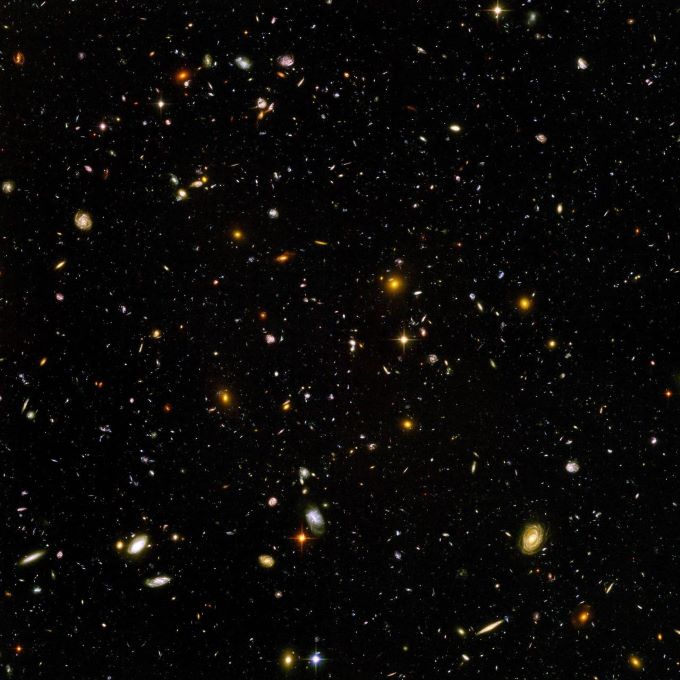
The creation of the universe is one of the most fascinating and mysterious events in the history of our world. Despite numerous theories and speculations, scientists are still unable to fully explain how the universe came into existence.
One of the most widely accepted theories is the Big Bang theory, which states that the universe was formed approximately 13.8 billion years ago. According to this theory, the universe started as a singularity, a tiny, incredibly dense and hot point in space. At this point, all matter and energy in the universe were compressed into a single location, and then suddenly exploded in a massive expansion, known as the Big Bang.
As the universe expanded and cooled, subatomic particles began to form, eventually combining to form atoms. These atoms clumped together to form clouds of gas and dust, which eventually became the first stars and galaxies. The formation of these first stars and galaxies marks the beginning of the universe as we know it today.
Over time, the universe continued to expand and evolve, as stars formed, burned out, and eventually exploded in supernovae. These explosions created new elements, including carbon and oxygen, which are the building blocks of life. It is believed that the conditions on Earth, which include the presence of liquid water, the right atmospheric composition, and a stable temperature, allowed life to emerge.
One of the most fascinating aspects of the creation of the universe is the idea of cosmic inflation, which states that the universe underwent a rapid expansion in the first fraction of a second after the Big Bang. This rapid expansion created the conditions necessary for the formation of the universe as we know it today, and it is also believed to have smoothed out any unevenness in the universe, making it the homogeneous and isotropic structure that we see today.
In addition to the Big Bang theory, there are other theories about the creation of the universe, including the Steady State theory and the Cyclic Model. The Steady State theory states that the universe has always existed and will continue to exist without beginning or end. This theory was popular in the 1940s and 1950s but was eventually discredited by the discovery of cosmic microwave background radiation, which provided evidence for the Big Bang.
The Cyclic Model, on the other hand, states that the universe goes through an infinite series of cycles, each consisting of a Big Bang followed by expansion, then contraction, and finally a Big Crunch. This cycle is then repeated, resulting in a new Big Bang and the creation of a new universe. While this theory is intriguing, it lacks the scientific evidence to support it and is not widely accepted by the scientific community.
Regardless of the theory that one subscribes to, the creation of the universe is an event that has left a profound impact on the world and continues to be studied and debated by scientists and philosophers alike. It is a reminder of the vastness and complexity of the universe, and of our place within it.
The creation of the universe remains one of the greatest mysteries of our time. Despite numerous theories and speculations, scientists are still unable to fully explain how the universe came into existence. From the Big Bang to the Cyclic Model, the theories about the creation of the universe continue to fascinate and inspire, reminding us of the incredible beauty and wonder of the world around us.


Great series, nice and compact for a quick read.