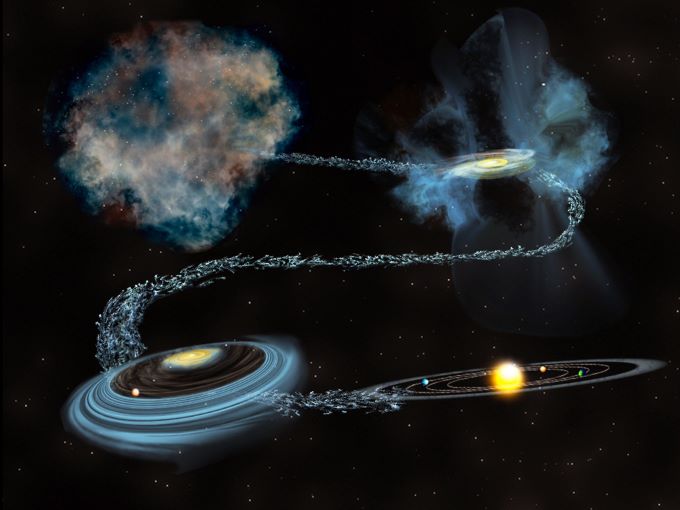
The formation of the Earth is a fascinating and complex subject that has been studied by scientists and philosophers for centuries. The exact process of how the Earth was formed is still not fully understood, but scientists have come up with several theories based on observational evidence. Here, we will explore the main theories about the formation of the Earth and discuss how our understanding of the formation of the Earth has evolved over time.
The first theory about the formation of the Earth is known as the nebular hypothesis. According to this theory, the Earth was formed from the remnants of a massive cloud of gas and dust known as the solar nebula. Over time, the gravitational force of the nebula caused the cloud to collapse and condense into a flat disk-shaped structure known as the protoplanetary disk. This disk was composed of gas, dust, and ice particles that slowly clumped together to form larger bodies, including the Earth.
One of the main pieces of evidence that supports the nebular hypothesis is the presence of a rocky inner layer surrounding the Earth, which is composed of heavy elements such as iron and nickel. Scientists believe that this layer was formed from the clumps of heavy elements that existed in the protoplanetary disk and were eventually pulled together to form the Earth.
Another theory about the formation of the Earth is known as the capture hypothesis. According to this theory, the Earth was formed from the collision of two smaller bodies in the solar system, which eventually merged to form a single, larger body. This theory suggests that the Earth was formed from the debris left over from the collision of two smaller bodies and was eventually captured by the gravitational pull of the Sun.
The capture hypothesis was originally proposed to explain why the Earth’s orbit around the Sun is so different from the orbits of other planets in the solar system. However, this theory has since been challenged by other observational evidence that suggests that the Earth was formed from the solar nebula.
The third and most recent theory about the formation of the Earth is known as the accretion hypothesis. This theory suggests that the Earth was formed from the gradual accumulation of smaller bodies over a period of millions of years. According to this theory, the Earth was formed from the collision and merger of smaller bodies in the solar system, which eventually merged to form a single, larger body.
This theory is supported by a large amount of observational evidence, including the presence of small impact craters on the surface of the Earth and the presence of similar impact craters on other planets and moons in the solar system. Additionally, this theory is supported by the presence of isotopes in the Earth’s mantle, which suggest that the Earth was formed from the gradual accumulation of smaller bodies over a period of millions of years.
The formation of the Earth is a complex and ongoing process that scientists have been studying for centuries. While the exact process of how the Earth was formed is still not fully understood, the nebular hypothesis, the capture hypothesis, and the accretion hypothesis provide us with a better understanding of how the Earth was formed and how our understanding of the formation of the Earth has evolved over time. Regardless of which theory is eventually proven to be correct, it is clear that the formation of the Earth is a fascinating and important subject that continues to capture the imagination of scientists and philosophers alike.