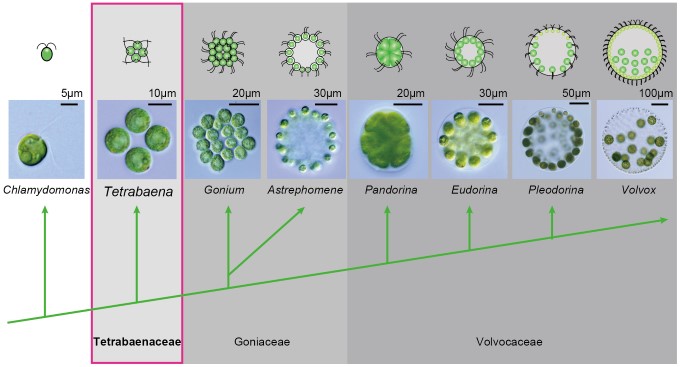
The evolution of single-celled organisms into multicellular life is a remarkable journey that has taken place over billions of years. Single-celled organisms, or prokaryotes, were the first forms of life to emerge on Earth and their evolution into multicellular organisms has led to the incredible diversity of life we see today.
It is believed that the evolution of multicellularity began around 2 billion years ago, when single-celled organisms started forming colonies or clusters. These clusters allowed the organisms to work together and carry out tasks that they couldn’t do on their own. For instance, some single-celled organisms would form a layer on the surface of a rock, providing protection from the elements, while others would form a filament, allowing them to move around and explore their surroundings.
With time, these clusters became more sophisticated and individual cells started taking on specific functions and roles. This marked the beginning of specialization, a key characteristic of multicellular organisms. For example, some cells would become specialized in photosynthesis, while others would be specialized in movement.
As multicellularity evolved, so did the organisms. They became more complex, with cells developing into tissues and organs that were dedicated to specific functions. For instance, some cells would become specialized in digesting food, while others would become specialized in detecting light or touch. This specialization allowed multicellular organisms to carry out more complex tasks and adapt to new environments and challenges.
One of the main drivers of the evolution of multicellularity was the need for increased efficiency. Single-celled organisms are limited in their ability to carry out complex tasks since they have to devote all their energy to performing basic life functions, such as reproduction and metabolism. However, by working together in multicellular groups, cells could divide up the workload and specialize in specific functions, allowing the group to perform tasks more efficiently and effectively than a single cell could.
Another important factor that contributed to the evolution of multicellularity was the need for increased protection. Single-celled organisms are vulnerable to predators, disease, and environmental stress, but by forming multicellular groups, they could better protect themselves. For instance, some cells in a multicellular organism might form a tough outer layer that protects the rest of the organism, while others might develop into immune cells that can fight off pathogens.
The need for increased mobility was another driving force behind the evolution of multicellularity. Single-celled organisms are limited in their ability to move and explore their environment, but by forming multicellular groups, they could become more mobile. For example, some cells in a multicellular organism might form specialized structures, such as legs or fins, that allow the organism to move around more effectively.
The evolution of multicellularity gave rise to a variety of different life forms, including plants, animals, and fungi. Each group has its own unique characteristics and adaptations that allow them to thrive in different environments. For example, plants have specialized structures, such as roots and leaves, that allow them to absorb nutrients and water from the soil, while animals have specialized structures, such as muscles and bones, that allow them to move and hunt.
Over time, multicellular organisms have continued to evolve and diversify, leading to the incredible diversity of life that we see today. From single-celled organisms to complex multicellular organisms, the evolution of life on Earth has been driven by the need for increased efficiency, protection, and mobility.
In conclusion, the evolution of single-celled organisms into multicellular life is a remarkable journey that has taken place over billions of years. From clusters of single-celled organisms to the diverse range of multicellular organisms.