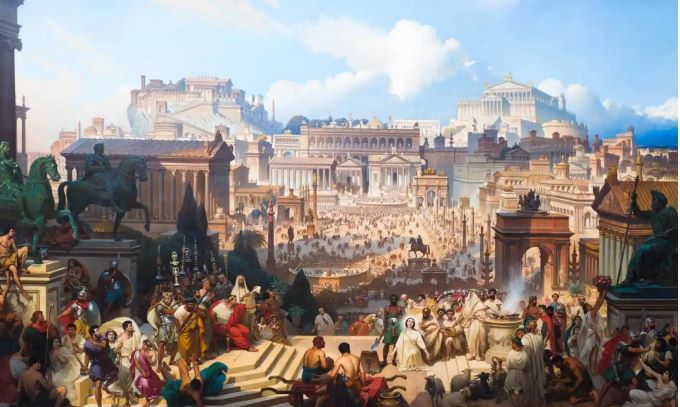
The rise of ancient Rome was one of the most significant events in world history, marking the beginning of one of the greatest empires the world has ever seen. Situated on the banks of the Tiber River in Italy, Rome grew from a small, agricultural community into a sprawling metropolis that would dominate the Mediterranean world for centuries.
The early history of Rome is shrouded in legend, but it is believed to have been founded in the 8th century BCE by Romulus and Remus. Over the next several centuries, Rome grew in size and power, gradually expanding its control over the surrounding regions and building a strong central government.
One of the key factors that contributed to the rise of ancient Rome was its military prowess. The Roman army was one of the most formidable fighting forces of the ancient world, and it was instrumental in the expansion of the Roman empire. Rome’s military prowess was built on a strong system of discipline and training, and its soldiers were known for their bravery and skill on the battlefield.
Another factor that contributed to the rise of ancient Rome was its political system. Rome was a republic for much of its early history, and its citizens enjoyed a high degree of political power and influence. The Roman Republic was characterized by a complex system of checks and balances, which helped to ensure that power was distributed fairly and that the interests of the people were protected.

The Roman Republic was eventually replaced by the Roman Empire in 27 BCE, when Augustus became the first emperor of Rome. Augustus was a strong and capable leader who brought stability and prosperity to the empire, and he set the stage for the next several centuries of Roman dominance.
The Roman Empire was known for its monumental architecture and engineering feats, such as the Colosseum, the Aqueducts, and the roads that connected the far-flung regions of the empire. The Romans also made significant contributions to the arts, literature, and sciences, and their legacy can still be seen in the modern world.
One of the most significant events in the rise of ancient Rome was the conquest of Greece in 146 BCE. The conquest of Greece brought a wealth of knowledge, culture, and ideas to Rome, and it helped to enrich the empire’s intellectual and artistic life. The Greeks were renowned for their contributions to philosophy, science, and literature, and their influence can still be seen in the works of some of the greatest thinkers and artists of the ancient world.
The rise of ancient Rome was also marked by a period of religious and cultural diversity. Rome was home to a vibrant and diverse array of religious and cultural traditions, and the empire was characterized by a tolerant and open-minded approach to religion and culture. This religious and cultural diversity was one of the hallmarks of the Roman empire, and it helped to create a rich and vibrant cultural heritage that still resonates in the modern world.

Despite its many achievements, the Roman empire eventually began to decline, and by the 5th century CE, it had fragmented into several smaller states. Nevertheless, the legacy of ancient Rome lives on, and its impact can still be seen in the modern world. From its monumental architecture to its contributions to the arts and sciences, the rise of ancient Rome remains one of the most important events in the history of civilization.
The rise of ancient Rome was a complex and fascinating process that saw the development of one of the greatest empires the world has ever seen. From its early days as a small, agricultural community, Rome grew into a sprawling metropolis that dominated the Mediterranean world for centuries. Its legacy can still be seen in the modern world, and its impact on the course of human history remains one of the most significant events of the ancient world.