The rise of ancient China was a remarkable and complex process that saw the development of one of the world’s oldest and greatest civilizations. Spanning thousands of years, the rise of ancient China saw the development of unique political, economic, and cultural systems that continue to influence the world today.
The earliest recorded history of China dates back to the Xia dynasty (circa 2070–1600 BCE), which was followed by the Shang dynasty (1600–1046 BCE). During this time, China saw the development of early forms of writing, bronze metallurgy, and the use of oracle bones for divination.
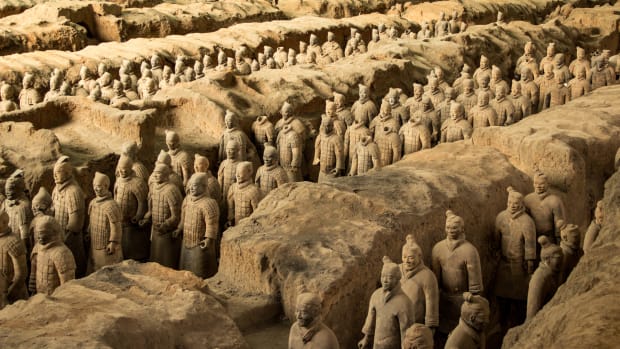
In 221 BCE, the Qin dynasty emerged, unifying the various warring states and establishing a centralized government. The first emperor, Shi Huangdi, embarked on a massive building program, constructing the Great Wall of China, the Terracotta Army, and a network of roads and canals. He also standardised the writing system, weights and measures, and currency, helping to unify the country and create a strong central government.
During the Han dynasty (202 BCE – 220 CE), China expanded its territory, became a major trading power, and made great advances in science, technology, and the arts. The Silk Road, which linked China with the West, was established, leading to the exchange of ideas, goods, and technologies between the two civilizations.
In the centuries that followed, China experienced periods of political instability and fragmentation, but it remained a major center of civilization and innovation. The Tang dynasty (618–907 CE) was a particularly prosperous period, known for its artistic and cultural achievements, including the development of a sophisticated poetry and music tradition.
In the late Tang period, the rise of the nomadic tribes from the north led to the decline of the dynasty and the establishment of the Five Dynasties and Ten Kingdoms period (907–960 CE). This was followed by the Song dynasty (960–1279 CE), which saw the development of a strong central government and the flourishing of science, technology, and the arts.

During the Ming dynasty (1368–1644 CE), China reached new heights of political stability and prosperity, with the capital city of Beijing becoming a major cultural and commercial center. The Ming dynasty also saw the expansion of the imperial bureaucracy, the growth of a merchant class, and the rise of a distinctive Chinese culture.
In the late Ming period, the rise of the Manchu state in the north led to the establishment of the Qing dynasty (1644–1912 CE), which was the last imperial dynasty in China. The Qing dynasty saw the expansion of the empire, the growth of a distinct Manchu culture, and the development of a sophisticated and centralized bureaucracy.
The rise of ancient China was marked by the development of unique political, economic, and cultural systems, which continue to influence the world today. From the imperial system and the Silk Road to the contributions to science, technology, and the arts, ancient China has left a lasting legacy that continues to shape the world.

The rise of ancient China was a remarkable and complex process that saw the development of one of the world’s oldest and greatest civilizations. Over thousands of years, China saw the emergence of unique political, economic, and cultural systems that continue to influence the world today. From the Xia dynasty to the Qing dynasty, the rise of ancient China is a testament to the resilience and innovation of the Chinese people, and a reminder of the profound impact that civilizations can have on the world.