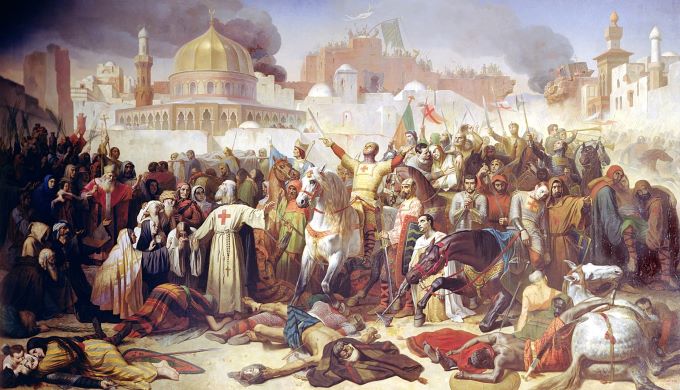
The Crusades were a series of military expeditions that took place from the late 11th century to the late 13th century, with the goal of recapturing the Holy Land from Muslim rule and establishing Christian control over the region. These expeditions were organized and led by the Roman Catholic Church and various European kingdoms, and they involved large armies of knights and soldiers traveling thousands of miles to the Middle East.
The Crusades were prompted by several factors, including the rise of Islam in the region, the perceived threat to Christian pilgrims visiting the Holy Land, and the desire of the Roman Catholic Church to expand its power and influence. The First Crusade was launched in 1095, and it was followed by several others over the next two centuries.

The Crusades had a profound impact on the political, religious, and cultural landscape of Europe and the Middle East. On the one hand, they helped to strengthen the power and influence of the Roman Catholic Church, as it was seen as the main driving force behind the expeditions. On the other hand, they contributed to the rise of nationalism and the development of a sense of European identity, as the various European kingdoms came together to participate in the expeditions.
The Crusades also had a significant impact on the relations between Christianity and Islam, as they were seen as a form of Christian aggression against the Muslim world. The wars and battles of the Crusades resulted in widespread violence, destruction, and loss of life, and they left a lasting legacy of mistrust and hostility between the two religions.

The Crusades were also significant for the development of medieval European society, as they provided an opportunity for knights and soldiers to gain experience and training in battle and for the growth of trade and commerce. The expeditions brought Europeans into contact with new cultures and ideas, and they helped to stimulate artistic and cultural exchange between Europe and the Middle East.
One of the most significant outcomes of the Crusades was the establishment of several Crusader states in the Holy Land, which were controlled by European Christians and served as a base for further military campaigns. These states also helped to establish a strong Christian presence in the region, which lasted for several centuries.

Despite their impact, the Crusades were ultimately unsuccessful in achieving their main goal of establishing Christian control over the Holy Land. By the late 13th century, most of the Crusader states had been reconquered by Muslim forces, and the European presence in the region was effectively ended.
The Crusades were a complex and significant event in world history, with far-reaching consequences for the political, religious, and cultural landscape of Europe and the Middle East. Despite their ultimate failure, the Crusades remain a fascinating and controversial topic of study, and they continue to shape our understanding of the relationships between religion, politics, and power in the medieval world.